
New York City just banned it for 600,000 students.
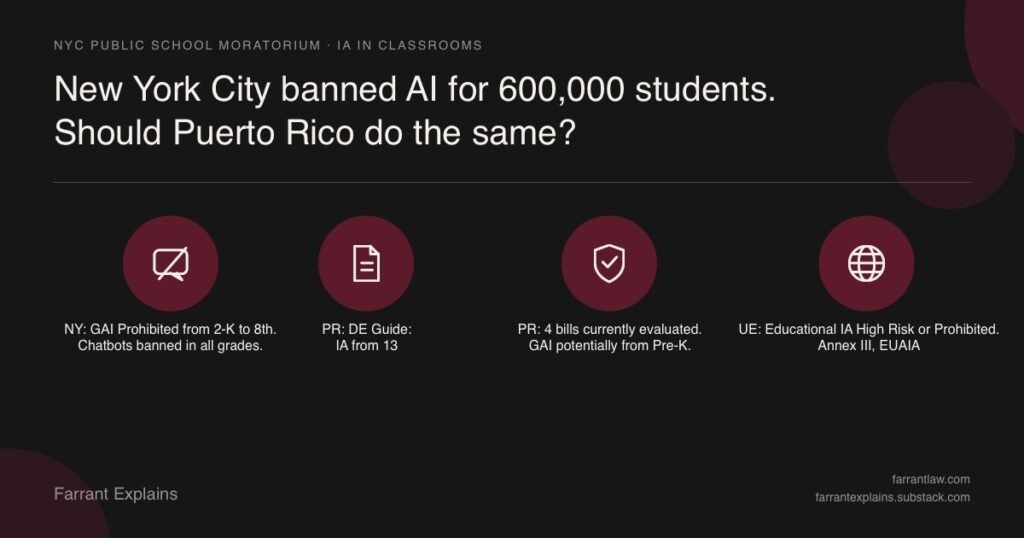
On September 2, 2026, New York City — through Mayor Zohran Mamdani and Schools Chancellor Kamar Samuels (equivalent to the city’s secretary of education) — did something no U.S. school system had done before: it paused the rollout of technology in the classroom, when they announced a 1-year moratorium on the use of generative artificial intelligence (”GAI”) in the city’s public schools. This means that, for the 2026-27 school year that has just begun, the roughly 600,000 students there in grades 2-K through 8th will not be able to use student-facing GAI. In addition, companion chatbots will be prohibited across all grades.
From a legal standpoint, perhaps the most striking thing about this announcement is that New York did not pass any law to impose its moratorium. The mayor and the chancellor simply made an administrative decision about what software would run on school devices, and with that decision, made a dramatic change in academic policy.
Their decision leads us to ask: are other jurisdictions passing laws on how AI is used in the classroom? Or, are these new technologies simply being rolled out through memoranda and administrative decisions? And, since we write from Puerto Rico, we ask ourselves: which model does our island follow — or could follow?
Before answering those questions, let’s start with a summary of the Mamdani and Samuels announcement.
What Did New York Actually Do?
The moratorium is far more detailed than what the headlines suggest. It is not an outright ban, but a framework that establishes the following:
- 2-K through eighth grade: A complete prohibition on student-facing GAI and chatbots that interact with students. Additionally, companion chatbots will be prohibited across all grades, from 2-K to high school.
- High school: Twice a year, students will receive a 45-minute AI literacy module covering fundamentals, bias, ethics, and the impact on the professions. In other words, they will be taught about AI, not with AI. While students at this level will fall outside the general moratorium, the ban on companion chatbots will apply to them.
- Pilot program: Up to 50,000 high school students (roughly 5% of enrollment) will have access to a pilot program with 5 approved AI tools (Quill, Edia, Brisk Teaching, Playlab, and Intel AI-Ready Schools) under strict time limits and teacher supervision.
- Screen time: For students in second grade and below, individual screen use (”1:1 screen time”) will be restricted, though that restriction has not yet been spelled out in detail; and caps of up to 30 minutes a day are recommendedfor third through fifth grade and 45 minutes for sixth through eighth.
- A “Technology in Schools Coalition” was created that will convene throughout the year and publish recommendations. On this, Chancellor Samuels stated in the mayor’s press release: “We’re standing firmly in our belief that innovation does not mean more technology, and over the next year, we will lead with evidence to make sure technology serves learning — not the other way around.”
- Important exceptions: AI may continue to be used in support programs for students with disabilities, multilingual learners, and career readiness programs. In addition, teachers may continue using AI for lesson planning and administrative work.
In short, New York City did not craft a policy out of “fear” of technology. It crafted one that distinguishes between AI as a tool “adults may use,” AI as a “subject students study,” and AI as “a thing that talks directly to a nine-year-old” — banning only that last category.
How Is AI Used in European Union Classrooms?
The European Union passed the EU AI Act (”EUAIA“), the most developed AI statute in the world, which, regulates the use of AI in education, among other areas. Notably, the EUAIA does not tell a school from what grade it may use AI. What it does is regulate the product: it imposes obligations on whoever develops and sells software or applications, and on whoever deploys the technology — including the school itself.
The EUAIA has 3 key provisions on this subject:
- Article 5(1)(f) prohibits developing, marketing, or using AI systems that infer the emotions of natural persons based on biometric data in educational institutions and the workplace, allowing only very narrow exceptions for medical and safety purposes. Accordingly, in the European Union, it is illegal for a vendor to offer a school a camera system that monitors whether students are actively participating in class.
- Annex III of the EUAIA classifies AI systems used in education as high-risk — particularly those that determine access to education, evaluate learning outcomes (including steering the learning process), assess the appropriate level of education, and monitor prohibited behavior during exams. A high-risk designation does not mean the product is banned, but that it will be heavily regulated. As of August 2, 2026, providers must maintain technical documentation and risk management systems, apply CE marking, register in an EU database, and provide for human oversight. Deployers, in turn —with schools included— must ensure adequate human oversight, retain logs for at least 6 months, notify individuals when they are affected by a high-risk system, and, if they are public entities, conduct fundamental rights impact assessments.
- Article 50 of the EUAIA adds transparency requirements across the board. Users must be told when they are interacting with a chatbot, when the content they are reading is AI-generated, and when emotion recognition systems are in use.
The EUAIA penalizes these violations with fines of up to the greater amount between €15 million or 3% of total worldwide annual turnover, and up to €35 million or 7% of worldwide annual turnover for prohibited practices.
In sum, the EU’s answer to “can a second-grader use a chatbot?” is: “that’s the school’s call. However, there is a compliance regime that will make deploying bad edtech expensive and make software that reads emotions illegal.”
What Has China Done About It?
In May 2025, China’s Ministry of Education issued guidelines regulating GAI in primary and secondary schools that resemble the one announced in New York City. For example:
- Primary school students are prohibited from independently using open-ended GAI content tools.
- Middle school students may explore and analyze the logical structure of AI-generated content, and understand how these systems work.
- High school students may engage in inquiry-based learning on the technical principles of AI and even develop and optimize AI models.
Separately, all students are barred from submitting AI-generated work as their own, using AI to cheat, or relying excessively on the technology for creative tasks without applying critical thinking. In addition, AI may not directly evaluate students or answer exam questions.
How Is AI Use in Schools Regulated in Puerto Rico?
Although Puerto Rico has enacted several laws on AI — such as Law 163-2026, which we covered previously — as of today, there is no law governing how AI may be used in a classroom.
The Puerto Rico Department of Education (”DE”), however, recently approved a policy that points in opposite direction from New York’s. Approved in December 2025 and published in January 2026, the Guía Para el Uso de la Inteligencia Artificial en el Aprendizaje Estudiantil (Guide for the Use of Artificial Intelligence in Student Learning, the “Guide“) names Microsoft Copilot, on its first page, as the official classroom platform for students aged 13 and up. The Guide further provides that only institutional accounts may be used when working with DE equipment and AI systems and, on page 23, establishes that students under 13 — or older students with academic delays or functional diversity — may use Learning Accelerators. It also requires that AI tools comply with federal and state data protection laws through the Office of Information Systems, and provides that students will be taught to not to enter sensitive personal information or information identifying other people. The Guide cites several reference sources, including recommendations from the U.S. Department of Education and UNESCO’s Recommendation on the Ethics of Artificial Intelligence.
Comparing the Guide against NYC, there is a clear contrast. The Guide provides that students at least 13 years old may use AI — an age likely borrowed from the federal COPPA statute, which imposes verifiable parental consent requirements on operators of websites and online services directed to children or that collect personal information from children under 13. COPPA does not set a minimum age for a minor to use a tool: it imposes obligations on the operator collecting the data. In other words, the Guide appears to have borrowed a threshold designed for a different problem. NYC, by contrast, draws its line at eighth grade — which on average means age 14 — and, unlike Puerto Rico, sets prohibitions rather than permissions.
The Guide is fundamentally about how students may use AI. NYC is trying to answer whether students may use AI.
Beyond the Guide, at least four bills on AI in education have been debated in the Puerto Rico Legislature, although, as of this writing (September 9, 2026), none has become law. They are:
| Measure | Filed | Sponsor | What it does | Status |
| P. de la C. (House Bill) 427 | 2025-03-20 | Rep. Tatiana Pérez Ramírez (PNP) and Rep. José F. Aponte Hernández (PNP) | 3-year pilot program deploying AI conversational-English tutors in 25 schools as passed by the House; the Senate committee report cuts it to 21 and adds that it begin in pre-K through third grade. | Passed the House on May 12, 2025. The Senate Committee on Science, Technology and Artificial Intelligence reported it with amendments on March 10, 2026; now before Senate Rules and Calendar. |
| P. del S. (Senate Bill) 348 | 2025-02-19 | Sen. Brenda Pérez Soto(PNP) with three co-authors: Karen Román Rodríguez (PNP), Gregorio Matías Rosario(PNP), and Rafael Santos Ortiz (PNP) | Establishes AI as an instructional and work tool across the DE, creates a compliance officer, and sets a pilot program in 2 high schools per region. Sets no grade or age limit on AI use. | Passed the Senate 24-0 on June 9, 2025 and the House 50-0 on reconsideration on January 29, 2026. The Senate rejected the House amendments on February 5, 2026. Now in Conference Committee. |
| P. del S. (Senate Bill) 820 | 2025-10-16 | Sen. Brenda Pérez Soto (PNP) | Establishes a media and digital literacy program across grades K-12, including algorithms, AI, and deepfakes. | Passed the Senate on March 26, 2026. The House Education Committee reported it on June 11, 2026; that report was withdrawn on June 25, 2026 and the bill returned to committee. |
| P. de la C. (House Bill) 968 | 2025-11-07 | Rep. José F. Aponte Hernández (PNP) | Requires the DE and all private schools to adopt ethical AI use policies. | In the House Education Committee since November 10, 2025. |
Before walking through each bill, two things are worth flagging at the outset:
- Both the House and the Senate filed AI implementation bills (348 and 427) in early 2025, and several months later filed governance bills (820 and 968). This matters because this order, in which a technology is adopted first and governed second would force Puerto Rico simply to “govern” what it “already bought,” rather than first establishing “whether it needs to buy” and “what to buy” before deciding what to buy. This process is not being followed due to lack of legislative will: 348 was approved unanimously in both chambers, yet it has sat for seven months in Conference Committee because the 2 chambers do not agree on the text.
- There appear to be legislative discrepancies about age. Although the House set no minimum age in 427, the Senate Committee on Science, Technology and Artificial Intelligence added that it AI instruction can begin in grades pre-K through third. However, this is the same committee that reported on 348, whose pilot plan begins in high school. So we have 1 committee, 2 bills, 2 opposite answers to the same question, and no explanation of how it arrived at the ages and grades each one proposes.
Now, Farrant Explains each bill:
1. House Bill 427 — The Senate Wants to Start Using AI Tutors in Pre-K
On May 12, 2025, the Puerto Rico House of Representatives passed P. de la C. 427, titled Ley para la Implementación de la Inteligencia Artificial en el Programa de Inglés del Sistema Público de Enseñanza en Puerto Rico (Act for the Implementation of Artificial Intelligence in the English Program of Puerto Rico’s Public School System). Filed by PNP Representatives Tatiana Pérez Ramírez and José Aponte Hernández, it orders the creation of a 3-year pilot program to integrate an AI tool to help improve conversational English learning in Puerto Rico’s public schools, that will be administered by the DE in collaboration with PRITS.
The text the House passed provided that the pilot program would cover 25 schools and set no grade level at all. However, the marked-up text accompanying the Senate committee report of March 10, 2026 changed that to 21 schools (3 per region) and added that the pilot begins in grades pre-K through third. Those ages contrast sharply with New York’s moratorium, which bars students between second and eighth grade from using conversational AI, and with China, which prohibits primary school students from independently using GAI. If 427 is enacted with the Senate amendment, it would mean that, starting in pre-K, Puerto Rican students will interact with GAI in the classroom.
This bill is very different from what New York City, Brussels, and Beijing have done, as it proposes:
- A 2-year pilot program giving priority to rural and hard-to-reach schools, and to students with low scores on standardized English assessments. The program would begin with a 6-month process to select the schools and tools and train teachers, followed by 3 years of tool use with continuous monitoring, and then a program evaluation.
- Requiring that the selected AI tools be capable of real-time, personalized interaction, provide immediate feedback on pronunciation, grammar, and fluency, and be compatible with the electronic devices available in public schools.
- Creating an Evaluation Committee appointed by the Secretary of Education.
- Providing annual reports to the Legislature and the Governor.
Separately, Article 7 of 427 as passed by the House required the AI tool to be selected “after the due process of evaluation and competitive bidding,” and titled the article “Tools to be used; competitive bidding.” The Senate’s marked up version struck the words “and competitive bidding” from both the heading and the body, leaving only “the due process of evaluation.” As people who believe in compliance with the law and government transparency, this deletion concerns us — particularly when what is being selected here is a system that will teach English to 4-year-olds in 21 public schools.
It is also notable that 427 says nothing about whether AI systems that measure or infer the emotions of natural persons based on biometric data will be permitted — a practice prohibited under Article 5 of the EUAIA.
2. Senate Bill 348 — Artificial Intelligence as a Work and Instructional Tool for Students and Teachers in the Puerto Rico Department of Education
This bill, filed by PNP Senator Brenda Pérez Soto 3 weeks before 427, is much broader in its scope, even though its pilot plan does start in high school. With regards to AI use, it sets no age or grade whatsoever. In fact, its Articles 3 and 5 authorize AI throughout the entire Department of Education.
If enacted, this bill would allow AI to be deployed across all courses as an instructional tool, not only in English classes. The bill also proposes:
- Creating the position of Compliance Officer, appointed by the Secretary of Education and charged with overseeing compliance with the act.
- Creating a technology innovation and AI unit under the Undersecretariat for Academic and Programmatic Affairs.
- Establishing a Pilot Plan in two high schools per educational region. One of the schools must be officially designated as a school under an improvement plan, and the other must not carry that designation. It is important to note here that Article 7 describes the pilot plan as one to “evaluate and implement educational and administrative strategies that promote improved academic performance at the high school level” — yet it never mentions AI. In a bill about AI, it is striking that the only article naming a school level does not say the pilot will be an AI pilot.
- Requiring that school communities — including parents and guardians — be given orientation on the ethical and responsible use of AI.
This bill, which has already been passed by both the House and the Senate but whose amendments were rejected by the Senate on February 5, 2026 and has been in Conference Committee ever since, is notable for the following:
- Its Article 3(b) provides that AI will be used as a tool to support and complement teachers’ work, and adds, in parentheses, “it shall not be to replace them.” It is the only 1 of the 4 measures that says so expressly — although placing a parenthetical clarification inside a declaration of public policy is highly unusual legislative drafting.
- The Article 7 Pilot Plan will be in high schools and not in pre-K, as 427 currently stands. However, as noted, that article does not mention AI, and the rest of the bill sets no grade level at all.
- Article 3(e)(5) requires that AI be used to “identify students at possible risk of failure: students who need additional support.” This would almost certainly be done through predictive risk profiling of minors — a practice the European Union has classified as a high-risk activity under its Annex III, since it would create an AI system used to evaluate academic outcomes or determine access to education. Operating such a system in the European Union would require compliance with obligations on documentation, logging, human oversight, and a fundamental rights impact assessment. In 348, however, this is a single clause that does not include any measurement standards, no human oversight requirement, no appeal process, and no rule barring that AI output from following the student through their academic record and transcript. While systems that identify at-risk students can help head off bigger problems, they can also turn into systems of “tracking and monitoring by algorithm.”
Finally, we can’t overlook the irony that both legislative chambers passed a bill to transform education in Puerto Rico containing a word in its title — instruccional — that is not recognized by the Royal Spanish Academy Dictionary. This is not an unavoidable technical term: the word appears to be adapted from the American term instructional design, and Spanish already has “instructivo,” which the dictionary does include. The syntax is worse. The title of the bill calls AI a “herramienta de trabajo e instruccional”, literally, “a tool for work and instructional.” That phrase uncomfortably yokes a noun phrase to a bare adjective. “Herramienta de trabajo e instrucción” would have done the job. All of it is a small sign of how much of Puerto Rico’s AI-in-education vocabulary is imported rather than drafted here.
3. Senate Bill 820 — Puerto Rico Media and Information Literacy Act
820 was also filed by PNP Senator Brenda Pérez Soto. If enacted, it would require the Department of Education to build a curriculum aimed at achieving media, digital, and statistical literacy among Puerto Rico’s public school students, so they can develop essential skills in critical thinking, information evaluation, data analysis, and technology use.
820 further provides that this instruction will be emphasized in Spanish, social studies, science, and mathematics, beginning within the next 2 academic years or sooner.
The curriculum seeks to have students develop literacy in:
- Critical evaluation of sources and verification of information.
- Identifying disinformation and manipulation — whether false information, deepfakes, manipulated images, sensationalist headlines (clickbait), or other forms of altered content.
- A basic understanding of how algorithms and artificial intelligence work.
- Fact-checking and corroboration, applying fact-checking methodologies, using digital verification tools, reverse image search, consulting multiple reliable sources, and triangulating information to confirm accuracy.
- Ethical and responsible production of digital content, including factual accuracy, proper source citation, and responsibility in disseminating information.
- Respect for privacy, intellectual property, and digital rights.
- Developing healthy habits in technology use.
- Interpreting data, identifying potentially misleading statistical representations, and critically analyzing quantitative information.
Implementation would rest on a continuing teacher training program, with certifications, microcredentials, and other verifiable credentials counting as professional development hours.
This bill is the closest to what New York City announced, since it seeks to have students know and understand algorithmic systems regardless of whether they use them in class. Its statement of motives, moreover, does its own comparative-law work, citing California’s AB 873 (2023) and its 2024 expansion, along with the strategies of Finland, Sweden, and Canada.
Its weakness, however, is similar to 968’s: it is an unfunded mandate. Article 10 simply directs the DE to implement it through “the optimization of existing human, technological, financial, and infrastructure resources within the Department of Education, maximizing the use of low-cost or free virtual platforms, open educational resources, collaborative alliances with universities and nonprofit organizations, and training in hybrid and virtual formats that reduce operating costs.” It is also silent on how age-appropriate curricula will be established, or at what age it will begin — a curious omission, given that the bill’s own premise is that children’s developmental stages make them vulnerable to manipulation.
4. House Bill 968 — Act on the Ethical Use of Artificial Intelligence in Puerto Rico Educational Institutions
This AI governance bill was filed by PNP Representative José Aponte Hernández. It is very different from 427 in that it does not mandate the deployment of any tool. Instead, it requires the DE to adopt and implement policies on the ethical use of AI in public schools and to oversee compliance with them. It likewise obligates every private educational institution registered under Law 212-2018 to adopt and implement similar policies at their respective academic entities and to file those policies with the Puerto Rico Department of State within no more than 180 days of the act’s approval.
968 establishes that every policy must include the following general principles:
- Security and protection.
- Autonomy.
- Privacy.
- Transparency and explainability.
- Diversity and inclusion.
- Responsibility and accountability.
Article 6 also requires that, “prior to the integration of artificial intelligence systems in public schools and private educational institutions, and in each subsequent school year, students and both teaching and non-teaching staff shall receive orientation and training on the ethics and responsible use of AI technologies in instruction, including the policies adopted.”
968 stands out as a bill that will require schools to enact policies with certain principles. However, it does not say anything about what constitutes a policy that fails to comply with the act, who will review those policies, or what happens when an institution files a deficient one. Nor does 968 establish penalties or authorize private civil actions to compel compliance. It also does not establish the ages at which an educational institution may deploy AI, leaving it to the discretion of each school.
There is also 1 provision that deserves special attention. The Privacy principle in Article 5 provides that “the informed consent of the user shall be guaranteed.” However, in a classroom, the user of the AI system is the student, and the bill says nothing about who consents when that user is a minor. It makes no reference to the Civil Code or to any other legal standard. As currently drafted, a school could satisfy this principle by obtaining informed consent from a 14-year-old. This is perhaps the most important provision across all 4 measures and, as presently written, does not require any parental involvement.
Why Should This Matter to You?
- Because it is worth examining how these bills seek to identify at-risk students. Senate Bill 348, for instance, devotes 1 clause to it. On the other hand, the EU classifies this as a high-risk AI use requiring documentation, human oversight, and a fundamental rights impact assessment. If some version of this bill passes, this provision will likely be the one posing the greatest risk of adversely affecting a student — and it currently has no accuracy standard and no appeal process outlined in the bill.
- Because if you work at a private school, you need to at least read House Bill 968 today. If your school is drafting an AI policy, it is worth preparing it — or revising your existing policies — along the 6 principles the bill sets out, so that you can comply with this bill if it becomes law.
- Because vendors of educational products in Puerto Rico may already be bound by very different laws. A company built to satisfy the EUAIA’s high-risk obligations will produce a materially different product from what might be permitted in Puerto Rico. If you are considering a vendor for your educational institution, we recommend asking whether its system complies with Annex III — a fast way to learn how seriously they take these requirements, even when local law does not demand it.
- Because if you care about parents being able to approve which educational programs their children use, you need to read 968 closely. It is the only bill that addresses informed consent, but it asks for it from the “user” — that is, the student — and says nothing about who consents on behalf of a minor. If that provision is stripped out, all that will remain for parents are the perception surveys mandated by Article 8 of 427, once the pilot has ended.
- Because Puerto Rico needs to define at what age its children may interact with AI. Although the Guide says “13 or older” as a general rule, 427 would begin in pre-K if the Senate amendment prevails; 348 sets no grade limit at all on AI use; and 968 leaves it to each educational institution’s discretion. As a result, there is no definitive answer or position on a question that New York, Beijing, and Brussels have all treated as fundamental.
- Because Puerto Rico appears to be charting a different course from the current consensus. The similarities among NYC, China, and the EU send a strong signal: these 3 systems, with very different policies, have independently concluded that their youngest students should not be talking to chatbots in the classroom. Those findings should be considered when a local law is taken up.
In Conclusion
New York City’s moratorium is significant because it was accomplished through a simple administrative decision, with no law at all. That was similar to what the DE did with the Guide — which set Puerto Rico on a very different course from NYC’s.
There is insufficient evidence at this time to say whether one approach is better than the other. It is a valid argument that a one-year moratorium protects a critical window in childhood development. An equally valid response is arguing that pulling AI out of classrooms widens the gap between students whose families let them access it from home and those whose families do not. House Bill 427 seeks to close that gap, and that is a legitimate goal.
In Puerto Rico’s case, however, what cannot currently be defended and needs to be reckoned with is that both legislative chambers filed bills to deploy AI in classrooms without first establishing a governance framework. The consequences of this decision are already visible: the most advanced bill has spent 7 months in Conference Committee after being passed unanimously by both the House and the Senate, precisely because there is no agreement on what it should say.
The order we propose is the one the EU used, prohibiting emotion inference in the classroom before the products arrived there, which is what New York City is doing this year: imposing a moratorium, convening a coalition, gathering evidence, and then making an informed decision.
Finally, if the Puerto Rico Legislature wants to create a lasting impact in this area, it is going to have to legislate it, and not leave it to each school’s discretion. When legislating, we believe it is essential to start with governance and principles, and then —once those are approved— begin implementation. That would avoid passing a bill that lets a kindergartner spend all day talking to and learning from a chatbot in the classroom, only to then seek a law saying whether that is appropriate and how it should be done.
If your school or educational products company wants to understand what standards apply in Puerto Rico, or wants to implement a governance policy on AI use at your institution, you can book a consultation with us today. We are here to help.