
Month: August 2026

Can I be Sued for Discrimination Under Puerto Rico’s Law 100 for Using ChatGPT at Work, Even if I Never Meant to Discriminate?

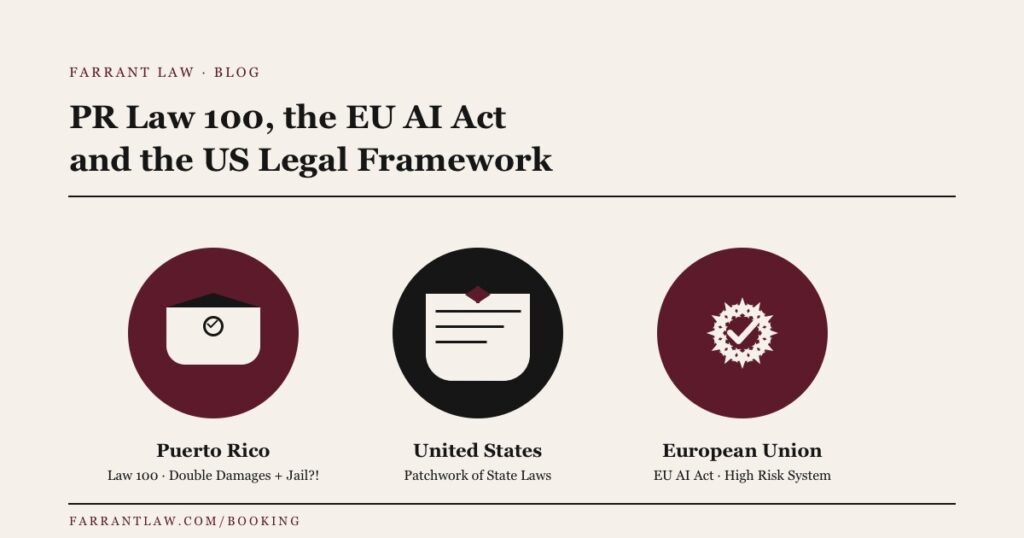
In our article published 2 weeks ago, we talked about how using AI to screen résumés exposes you to laws that prohibit workplace discrimination. Today, we want to focus on the risks you face if you operate in Puerto Rico under a law that almost no vendor will mention when you’re evaluating an automated “screening” tool: Law Num. 100 of June 30, 1959, Puerto Rico’s employment discrimination law, which applies even though its text doesn’t contain the word “algorithm” — and adds consequences that neither U.S. federal law nor the European Union impose.

What Does Law 100 Presently Say?

Before 2017, Law 100 gave employees a powerful tool: it provided that an adverse action — such as failing to hire, failing to promote, or terminating someone — taken without just cause, was presumed to be discriminatory. Once the employee triggered that presumption, the burden shifted almost entirely to the employer, who then had to affirmatively prove that no discrimination had occurred.

That changed with the Labor Transformation and Flexibility Act (Law 4 of 2017), which eliminated that presumption in order to align Puerto Rico with the federal standard known as McDonnell Douglas. Today, a claim under Law 100 works much like a federal one: the employee must establish a preliminary case (that they belong to a protected class, that they were qualified, that an adverse action occurred, and that similarly situated people outside that protected class were treated better). Once an employee does this, the employer must articulate a legitimate, non-discriminatory reason for the decision. If the employer does so, the burden shifts back to the employee, who must then prove that reason was pretextual.

In short: today, the burden of persuading the court that discrimination occurred rests more on the employee than on the employer.

However, AI introduces a real problem for employers even under this favorable standard. As mentioned above, the second step of the analysis requires you to be able to articulate a legitimate reason for the rejection. If your entire process was uploading résumés to a third-party tool and letting an algorithm screen them out, what is your legitimate reason for rejecting them? Answering “The system gave them a lower score” isn’t always enough — especially if the candidate can show, through statistics (as allowed under Title VII’s disparate-impact theory), that the tool’s rejection pattern — for example, disproportionately screening out women for a position — correlates with a protected category. In that scenario, your inability to explain the decision becomes the very evidence of pretext the candidate or employee needs to prevail.

That said, even though the burden of proof is no longer automatically stacked against the employer, Law 100 still has something Title VII doesn’t: harsher penalties, discussed below.

What Are the Penalties Under Law 100?

Law 100 imposes civil liability on the employer for double the damages caused (or between $500 and $2,000 if damages cannot be determined). In addition, discriminatory conduct may constitute a misdemeanor, punishable by a fine of up to $5,000 or up to 90 days in jail, or both. None of this exists under any federal anti-discrimination law. As a result — although it is uncommon for these cases to be prosecuted criminally — using AI to screen résumés could technically expose you to criminal liability in Puerto Rico. It’s a consequence many employers don’t know about or anticipate.

How Is This Regulated in Other Jurisdictions?

  • United States: there is no single federal law governing AI in employment. Instead, there’s a patchwork of local and state rules — New York City’s Local Law 144, which mandates bias audits; Illinois’s requirement to notify candidates when AI is used to analyze video interviews; Colorado’s risk assessments — layered on top of existing federal anti-discrimination laws (Title VII, ADEA, ADA) enforced by the EEOC and interpreted under the U.S. Supreme Court’s McDonnell Douglasstandard. All of these can be boiled down to: you’re allowed to use AI tools, but be ready to justify them if challenged — and know the specific compliance requirements in whatever state you operate in or evaluate candidates from.
  • European Union: if your company works with candidates or employees in the EU, or you simply want to understand where AI regulation is headed globally, it’s worth looking at the EU AI Act (Regulation (EU) 2024/1689), already in force, and likely the most comprehensive legal framework on artificial intelligence in the world today. The EU AI Act classifies AI tools used for recruitment and personnel selection — including filtering job applications and evaluating candidates — as “high-risk” systems. That means that before they can be legally used, the tool must undergo a conformity assessment, have technical documentation, risk-management systems, human-oversight mechanisms, and be registered in an EU database. Employers also have a specific obligation to inform workers and their representatives of the system’s existence before using it. In the European Union, unlike in Puerto Rico and the United States, an employer must demonstrate that its platform is safe before using it.

The difference in approach is significant. While the EU certifies the tool before it’s used, Puerto Rico and the United States require nothing upfront, but impose legal consequences if the tool produces a discriminatory result.

Why Should This Matter to You?

Because using AI that discriminates against candidates puts you at risk of paying damages — and if you’re in Puerto Rico, it puts you at risk of criminal liability.

Think about it in practical terms: if your AI tool disproportionately rejects candidates of a certain age or background, and a candidate manages to prove pretext — for example, by showing that you couldn’t coherently explain why the system screened them out — you face the possibility of having to compensate the people affected by the algorithm, and of being held criminally responsible for having used it. For a small business or a clinic, that’s a genuinely significant exposure that goes beyond what you’d anticipate if you only looked at federal law as your benchmark, or if you assumed you were covered because ChatGPT was built “without any intent to discriminate” or because you used the AI tool in “good faith.”

How Can I Comply With the Law?

  1. Always have an articulable reason for every rejection. “The system gave candidate X a lower score” isn’t enough on its own. You need to be able to explain, in concrete terms tied to the job’s qualifications, why a candidate didn’t move forward in the interview process.
  2. Demand documentation from your vendor. Ask whether the tool has been bias-audited, how often, and whether they’ll provide you that documentation. That evidence is what lets you satisfy the “articulate a legitimate reason” step if it is challenged.
  3. Keep a record of every decision. What data went in, what score or result the system produced, and what human review occurred before each final decision. That log is your evidence if you ever need to defend the process.
  4. Notify candidates that you use AI in the process. It’s good practice in Puerto Rico, and it’s already mandatory under the EU AI Act if you have candidates or employees in Europe.
  5. Run a risk assessment before adopting the tool — not after the first complaint. Ask yourself: what data was it trained on? Which protected categories might it be indirectly affecting? Remember that Law 100 protects, among others: age, race, color, sex, sexual orientation, gender identity, social or national origin, social condition, political affiliation, political or religious beliefs, being a victim (or perceived victim) of domestic violence/sexual assault/stalking, veteran status, marital status, and even certain hairstyles and hair textures associated with particular racial identities or national origins.
  6. Review your contract with the vendor. Who’s responsible if the tool produces a discriminatory result? Negotiate that clause if you can.

The Bottom Line

Since the 2017 labor reform, Law 100 no longer puts you in a worse evidentiary position than federal law. What does set Puerto Rico apart is what happens if you lose: double damages and the possibility of criminal liability, neither of which exists under Title VII. Remember, too, that if you can’t explain why your tool rejected a candidate, you may already be in violation of the law. Finally, remember that you need to keep your processes documented, make sure they’re supervised by people, and be able to explain and justify every decision. Know and formalize your processes before you’re forced to do so in front of a government agency or a court.

Do you think your current AI-driven hiring process could expose you to legal liability under Ley 100 if a candidate filed a complaint today — or do you just want to make sure your processes are compliant? Let’s talk. Book a consultation here.

About the Author

Jaime Farrant is admitted to practice law in Puerto Rico, New York, Maryland and the District of Columbia. Practice in all other jurisdictions is limited to immigration law. This article is for informational purposes only and does not constitute legal advice or create an attorney-client relationship.

ADVERTISING MATERIAL. This article constitutes advertising as defined by the professional conduct rules in New York (22 NYCRR 1200.7.1 and 1200.7.3), Maryland (Rule 19-307.1 and 19-307.2), and the District of Columbia (D.C. Rules of Professional Conduct 7.1), and the Puerto Rico Rules of Professional Conduct (Rules 7.1-7.3). It is not solicitation of prospective clients known to need legal services in a particular matter. Instead, it is general information directed to the public about the practice of law and available legal services. No attorney-client relationship is created by your reading of this article or by contacting the author. Consult qualified counsel in each jurisdiction with specific situations.
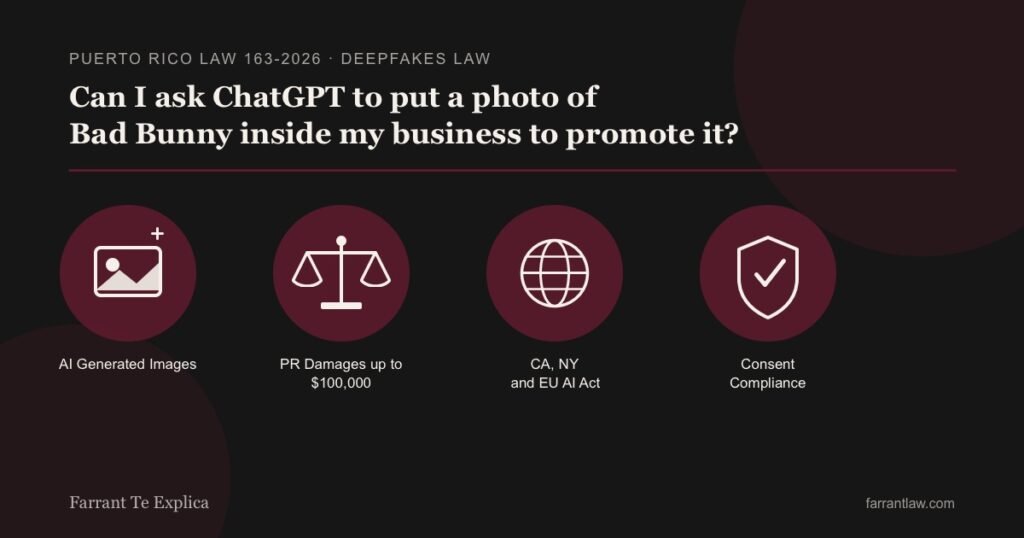
Can I Use ChatGPT to Put Bad Bunny in my business’s social media ads?

As I write this post, social media in Puerto Rico has blown up with Bad Bunny’s announcement that he will close his world tour in concert scheduled for August 22 and 23 in San Juan’s Hiram Bithorn Stadium. The amount of posts about this announcement reminded me of the many promotions posted by Puerto Rican restaurants, bars, and small businesses in their Facebook, Instagram and TikTok accounts, where they showed a photo of Bad Bunny eating at their restaurant, or having a beer at their bar. However, he was never in any of these places. These were AI-generated images, posted without his consent, for one obvious reason — to draw customers to their businesses using the likeness of arguably the most recognizable person in Puerto Rico today.  However, no business paid a license, asked permission, or, in most cases, thought twice about it.

If your business operates in Puerto Rico, New York, Maryland, or Washington D.C., the answer to whether you can legally do this depends heavily on which of these you’re in — and the gap between them is bigger than most business owners realize.

In the US, How – or If – you can use Deepfakes Depends Entirely on Where You Live

Unlike Puerto Rico, which just amended its “Right to One’s Own Image” statute (Law 139-2011, as amended by Law 163-2026) to explicitly cover AI-generated deepfakes by penalizing their unauthorized commercial use with damages of up to $100,000 per violation if the use was intentional or with gross negligence, the United States has no uniform federal right of publicity. Each state decides for itself whether — or how — to protect someone’s name, voice, or likeness from unauthorized commercial use. That means that the same AI-generated Bad Bunny photo can be a serious legal problem in one state and close to unregulated in the state next door.

New York: The Strongest Protections of All

New York has protected this right since long before generative AI existed. Civil Rights Law §§ 5051 makes it a misdemeanor — and a civil cause of action — to use a living person’s name, portrait, picture, likeness, or voice for advertising or trade purposes without their prior written consent. Section 51 lets the injured person seek an injunction, actual damages, and, if the defendant knowingly used their likeness, exemplary (punitive) damages at the jury’s discretion.

On top of that foundation, New York has added two AI-specific layers in the last 2 years:

  • The Digital Replica Contracts Act (General Obligations Law § 5-302): voids contract provisions that let an employer replace a performer’s actual performance with a digital replica, unless the performer was represented by counsel or a union and the terms are stated clearly in a separately signed agreement.
  • The Synthetic Performer Disclosure Law (General Business Law § 396-b), effective June 9, 2026: requires advertisers to conspicuously disclose when an ad contains a “synthetic performer” created using generative AI. Civil penalties run $1,000 for a first violation and $5,000 for each subsequent one.

Put together, a New York business running that “Bad Bunny at my bar” photo is exposed on two fronts: a §§ 50–51 claim from Bad Bunny himself (or his estate, for that matter, since New York also protects deceased performers’ digital replicas under Civil Rights Law § 50-f), and a separate disclosure penalty if the ad used a synthetic element and didn’t label it.

Maryland: Barely Any Legal Protections at All

This is likely to surprise business owners coming from New York or Puerto Rico: Maryland has no right of publicity under its statutes or common law. It’s one of only a handful of states (along with Alaska, Kansas, and North Carolina) where this right doesn’t exist as such. A bill that would have created a civil cause of action for unauthorized use of someone’s identity via AI or deepfakes — House Bill 1425/Senate Bill 905 — did not pass in the 2025 session. It’s been reintroduced as House Bill 184 for the 2026 session, but as of this writing, it has not been approved.

Maryland does have a deepfake statute — Senate Bill 141 (2026), effective June 1, 2026 — but it is narrowly limited to election-related deepfakes intended to influence voting or misrepresent election facts. It has nothing to say about a restaurant using an AI-generated photo of a celebrity to sell arepas, margaritas or mofongo.

Practically, this means that today, a Bad Bunny impersonation ad run by a Maryland business faces essentially no exposure under Maryland state law specifically built for this problem. That could change if HB 184 passes, and it’s also worth remembering that Bad Bunny himself could still bring a claim in a state where he does have rights like New York, depending on where the harm occurred.

Washington D.C.: Regulated by Common-Law, Not a Statute

D.C. has no right-of-publicity statute either. What it has is a common-law claim for misappropriation, drawn from the Restatement (Second) of Torts § 652C, as applied in Vassiliades v. Garfinckel’s, Brooks Bros., 492 A.2d 580 (D.C. 1985). To win, a plaintiff has to show both that the defendant benefited from using their identity and that there’s a recognizable public or commercial value in that identity — the exact opposite of a bright-line statute like New York’s. This makes outcomes far less predictable and cases more expensive to bring, since there’s no statutory damages figure to point to and no per-violation civil penalty to threaten a defendant with.

How is This Regulated in the European Union?

The European Union has taken an approach very different than the patchwork of state laws in the US through its enactment of the EU AI Act, which applies across all Union states. The EU AI Act does not establish a standalone private right of action for damages; rather, it imposes administrative transparency obligations. Under Article 50 of the Act, providers of Al systems that generate or manipulate image, audio, or video content constituting a deepfake must clearly disclose that the content has been artificially generated or altered. An exception applies when such content is part of an obviously artistic, satirical, or fictional work, provided it is not presented in a misleading manner. Failure to comply with these transparency requirements constitutes a serious infringement, subject to administrative fines of up to €15 million or 3% of the undertaking’s total worldwide annual turnover for the preceding financial year, whichever is higher.

Why Should This Matter to You?

If you run a business — or advise clients who do — across any of these jurisdictions, the question “can I use an AI image of a celebrity in my ad” doesn’t have one answer, and responses range from “yes, expect a lawsuit and pay damages of up to $100,000” (Puerto Rico), to “yes, expect a lawsuit and possible punitive damages” (New York) to “there’s currently no statute built for this” (Maryland) to “it depends on how a judge applies a 40-year-old privacy tort” (D.C.), or “you must publish in your campaign that its content was artificially generated” (EU). Consequently, a marketing decision that’s clearly reckless in Manhattan might be legally uneventful across in Maryland — for now.

These differences are exactly the kinds of gaps that generative AI has widened. Tools like ChatGPT, Claude, Midjourney, and similar platforms make it trivial to generate a photorealistic image of a real, identifiable person for a fraction of what a licensing deal would have cost a few years ago. The law in most of the United States hasn’t caught up uniformly, which means your exposure depends less on what you did and more on where you did it.

How Can You Comply With the Law?

  • If you operate in New York, treat any AI-generated image or voice of a real person in your advertising as requiring the same written consent you’d need for a real photo — Civil Rights Law § 51 doesn’t distinguish between a real photograph and a generative AI recreation.
  • If your New York ad uses a synthetic performer (not a real, identifiable person, but a “no such person exists” AI-generated model), confirm you’re including the conspicuous disclosure required by GBL § 396-b before it airs.
  • If you operate in Maryland, don’t assume the absence of a right-of-publicity statute means zero risk — track HB 184, and remember a claim can still be brought in a state where the depicted person has stronger rights.
  • If you operate in D.C., document your process for obtaining consent regardless of the weaker legal baseline; a misappropriation claim can still succeed, and consent is always the safer route.
  • If you operate in Puerto Rico, make sure your processes clearly document that the use was authorized.
  • If you operate across multiple states, apply the strictest applicable standard (in this example, New York’s) to any content you plan to run across state lines or online, since your audience — and any resulting claim — isn’t limited to where your business is physically located.
  • If your campaign will be shown in the European Union, you will have to divulge that it was artificially generated.

The Bottom Line

Puerto Rico, New York, Maryland, D.C., and the European Union sit at very different points on the right-of-publicity spectrum — from New York’s statutes with real teeth, to Maryland’s near-total absence of protection, to D.C.’s uncertain common-law doctrine. If your business uses generative AI in marketing and you operate in more than one of these jurisdictions, the safest approach is to assume the strictest rule applies everywhere your content is seen, not just where you’re physically located.

Does your business use AI-generated content in advertising across New York, Maryland, or D.C.? Schedule a consultation today to review your exposure in each jurisdiction where you operate.

About the Author

Jaime Farrant is admitted to practice law in Puerto Rico, New York, Maryland and the District of Columbia. Practice in other jurisdictions is limited to immigration law. This article is for informational purposes only and does not constitute legal advice or create an attorney-client relationship. Laws referenced are current as of August 15, 2026.   

ADVERTISING MATERIAL. This article constitutes advertising as defined by the professional conduct rules in New York (22 NYCRR 1200.7.1 and 1200.7.3), Maryland (Rule 19-307.1 and 19-307.2), and the District of Columbia (D.C. Rules of Professional Conduct 7.1), and the Puerto Rico Rules of Professional Conduct (Rules 7.1-7.3). It is not solicitation of prospective clients known to need legal services in a particular matter. Instead, it is general information directed to the public about the practice of law and available legal services. No attorney-client relationship is created by your reading of this article or by contacting the author. Consult qualified counsel in each jurisdiction with specific situations.

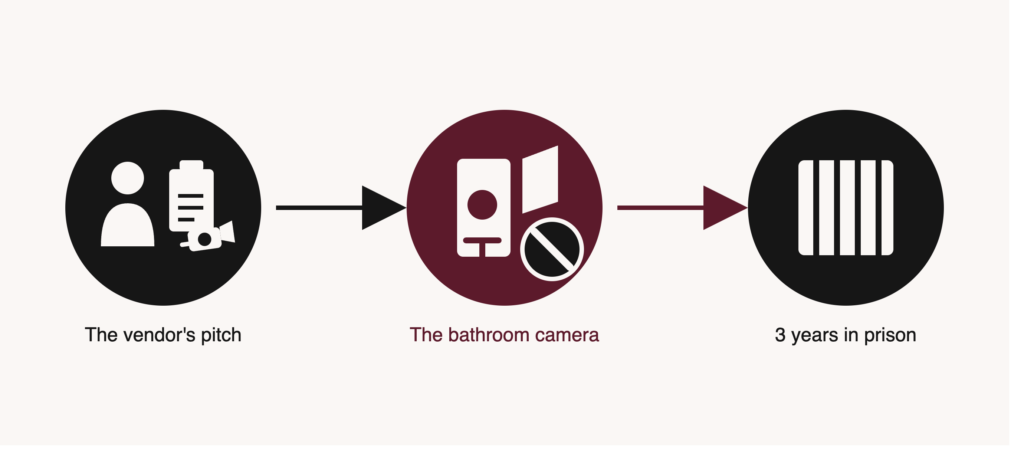
Your Security Camera Vendor Wants to Cover Your Bathroom – Is that Worth 3 Years in Jail?

A security vendor offers you a great deal: a full camera package for your office or clinic, including units for “every room” — bathrooms included. Before you say yes, here’s the one word that should stop you: no.

Installing a camera in a bathroom isn’t a gray area. In most states, it’s either a specific criminal offense, an actionable civil tort, or both — regardless of whether you own the building, whether employees consented to “general” workplace monitoring, or whether your intent was purely about theft prevention.

All Kinds of Laws and Regulations Are Against Your Vendor’s Sales Pitch

Video surveillance law in the U.S. is a patchwork, but one principle is close to universal: people have a reasonable expectation of privacy in spaces where they may be nude or partially undressed — bathrooms, locker rooms, and changing areas top that list in nearly every jurisdiction.

The following layers of law apply here:

1. The federal wiretap/ECPA gap doesn’t help you here. Most security cameras don’t record audio, which is why they generally fall outside the federal Wiretap Act and the Electronic Communications Privacy Act (those statutes govern communications, not silent video). Business owners sometimes hear “no audio recorded, no ECPA problem” and assume that means video is unregulated. It isn’t. ECPA’s silence on soundless video just means you have to look elsewhere — and state law fills that gap fast, especially for restrooms.

2. State statutes specifically ban restroom and changing-area recording. California, for example, expressly forbids video recording in restrooms, locker rooms, and places where people change clothes. Many states have similar “video voyeurism” or “unlawful surveillance” statutes that criminalize recording — or even just installing recording equipment — in a place where someone has a reasonable expectation of privacy, whether or not any footage is ever viewed or used. These are often felony-level offenses, and consent from you as the business owner is irrelevant; the person being recorded is the one whose consent (or knowledge) matters.

3. Healthcare and other regulated settings add another layer. If you run a medical office, a bathroom camera also raises immediate collateral problems: patients or staff visible on camera in a restroom implicates dignity and privacy obligations that go well beyond HIPAA’s technical safeguards — it’s the kind of fact pattern that turns into a licensing board complaint, a media story, or both.

4. Even without a specific statute, common law will find you. Every U.S. jurisdiction recognizes some version of the tort of intrusion upon seclusion: intentionally intruding on someone’s private affairs in a way that would be “highly offensive to a reasonable person.” A camera in a bathroom is the textbook example courts use to illustrate this tort. That means even in a state without a dedicated criminal statute, an employee, patient, or customer who discovers the camera can sue you civilly — and juries tend to have little patience for this fact pattern.

What Does Puerto Rico’s Constitution and Penal Code Say?

If you operate in Puerto Rico, your exposure is arguably higher than in the 50 states, as the right to privacy here isn’t left to a patchwork of state statutes and common-law torts. It’s written directly into the Constitution.

Article II, Section 8 of the Puerto Rico Constitution states: “Toda persona tiene derecho a protección de ley contra ataques abusivos a su honra, a su reputación y a su vida privada o familiar” (Every person has the right to protection of law against abusive attacks on their honor, reputation, and private or family life). What makes this different from the U.S. Constitution is that the Puerto Rico Supreme Court has held that this right applies directly between private parties, not just against government action. In Arroyo v. Rattan Specialties, Inc., 117 D.P.R. 35 (1986), the Court held that the right to privacy operates ex propio vigore — on its own force — and can be asserted by one private citizen against another, including an employer against an employee. That means a bathroom camera dispute in Puerto Rico doesn’t need a separate statute to become a constitutional violation; the Constitution itself solves the controversy.

The Puerto Rico Penal Code then backs this up with a specific criminal provision. Article 168 of the Puerto Rico Penal Code, titled “Illegal recording of images”, makes it a crime for any person, without legal justification or a legitimate investigative purpose, to use electronic or digital video equipment — with or without audio — to conduct secret surveillance in private places, or in any other place where a reasonable expectation of privacy exists. A bathroom is about as clear an example of that as exists. Conviction of this crime carries a 3 year imprisonment penalty, and if the convicted party is a corporation (or any legal person), they face a criminal fine of up to $10,000, on top of civil liability.

Put together, that’s 3 independent legal problems stacked on top of each other for accepting the salesperson’s offer: a constitutional privacy violation that doesn’t require a lawsuit-specific statute to exist, a specific criminal statute naming the conduct, and civil liability for damages. There’s no version of “we didn’t think it applied to us” that survives this situation.

What Will “Getting This Wrong” Cost You?

You will face real exposure across all fronts, notably:

  • Criminal liability: Many state voyeurism/unlawful surveillance statutes are felonies, carrying fines and potential jail time for the person who installs or operates the equipment — that could be you, personally, not just “the business.”
  • Civil damages: Intrusion-upon-seclusion claims, among other tort claims, can result in compensatory damages, and courts in the US have allowed punitive damages where the conduct is found egregious — a bathroom camera is close to the paradigm case.
  • Employment claims: If the person recorded is an employee, expect this to also surface as a hostile work environment or wrongful termination claim if discipline follows the discovery.
  • Reputational cost: Unlike a data breach notice, this is the kind of story that runs on local news with your business’s name in the headline. There’s no regulator fine that costs you more than the client and patient trust it destroys.

Why Should You Care About This?

Because although you might think the sales pitch sounds reasonable, you could end up in a lot of trouble. “Fully covered and protected business” sounds like a good security practice, and most business owners installing these systems aren’t trying to do anything invasive — they’re thinking about delivery problems, break-ins, shoplifting, and slip-and-fall liability. However, your good intent doesn’t matter for most of these statutes, and it won’t matter to a jury either. The law doesn’t ask whether you meant well; it asks whether a reasonable person would find being recorded in that space highly offensive. In a bathroom, the answer is already decided.

This is also a useful moment to audit your entire camera plan, not just the bathroom question — because the same vendor conversation is a good opportunity to think through where cameras are legally fine (entrances, sales floors, hallways, parking areas) versus where they cross the line (restrooms, break-rooms used for nursing mothers, private offices with an expectation of confidentiality).

What Can You Do to Comply?

  1. Decline any bathroom, locker room, or changing-area camera outright. There’s no notice, consent form, or signage that fixes this. Don’t install it, and don’t let a vendor bundle it into a package “in case you change your mind.”
  2. Map your camera locations against expectation-of-privacy zones. Entrances, registers, storage, parking, and common work areas are generally fine. Restrooms, changing rooms, and private offices are not.
  3. Put your monitoring policy in writing. For the cameras you do install, a written policy — reviewed by an attorney — that discloses locations, purpose, and retention helps establish notice and reduces the risk of a monitoring-related claim from staff.
  4. Check your state’s specific statute. Voyeurism and unlawful-surveillance laws vary — some cover only “for sexual gratification” purposes, others cover any recording in a private space regardless of purpose. If you operate in Puerto Rico, the relevant provision is Article 168 of the Penal Code — broader than many mainland statutes since it isn’t limited to a sexual-purpose requirement.
  5. Train whoever manages the footage. Access controls and retention limits for legitimate camera footage matter too — who can view it, how long it’s kept, and how it’s secured.

The Bottom Line

Say yes to the cameras. Say no to the bathroom units — every time, no exceptions, regardless of how the package is bundled or how good the discount is. This is one of the few areas of privacy law where there’s no compliant way to do the thing at all; the only right answer is not installing it.

If you’re building out a security camera plan for your office, clinic, or retail space and want a compliance check before you sign anything, book a consultation — better to ask before the cameras go up than after.

This post is for general informational purposes and does not constitute legal advice. Camera and surveillance laws vary by state; consult an attorney about the rules that apply to your specific location and industry.

About the Author

Jaime Farrant is admitted to practice law in Puerto Rico, New York, Maryland and the District of Columbia. This article is for informational purposes only and does not constitute legal advice or create an attorney-client relationship.

ADVERTISING MATERIAL. This article constitutes advertising as defined by the professional conduct rules in New York (22 NYCRR 1200.7.1 and 1200.7.3), Maryland (Rule 19-307.1 and 19-307.2), and the District of Columbia (D.C. Rules of Professional Conduct 7.1), and the Puerto Rico Rules of Professional Conduct (Rules 7.1-7.3). It is not solicitation of prospective clients known to need legal services in a particular matter. Instead, it is general information directed to the public about the practice of law and available legal services. No attorney-client relationship is created by your reading of this article or by contacting the author. Consult qualified counsel in each jurisdiction with specific situations.