
Do you know how much money your child’s YouTube channel has generated—and where you’ve deposited it?
Nowadays, it’s almost impossible to scroll through YouTube, Facebook, TikTok, or Instagram without stumbling upon accounts where 4-, 6-, or 8-year-old children are genuine performers: unboxing toys, reacting to challenges, or simply living their daily lives in front of a camera operated by their parents. The content they post frequently generates income from advertising, sponsorships, and affiliate links. Until a few weeks ago, Puerto Rico had no law that guaranteed that child received a single cent of what their image generated.
That changed on June 19, 2026, when the Puerto Rico Legislature approved Senate Bill 973, and Governor Jenniffer González Colón signed it into Law 193-2026, known as the “Law for the Economic Protection of Minors in Digital Monetization.” Today, Farrant Explains what this new law establishes, how it works in practice, and how it compares to similar laws in the United States and the European Union.
What Does Law 193 Establish?
Law 193 is built on a simple premise: if a minor’s image, voice, or identity is the principal engine driving content that generates money, that minor has the right to receive a portion of those earnings when they reach adulthood, and someone is legally required to answer for the proper management of that money.
Law 193 creates several new legal categories to accomplish this. The first is the “minor content creator”—any person who has not reached 21 years of age (or less, if emancipated) and participates in the creation or production of digital content that generates direct or indirect income. The Law also defines the “responsible content creator” as the parent, mother, or legal guardian who administers the account or channel and receives the earnings. Finally, the law establishes the “protected account”: a bank account held exclusively in the minor’s name at an institution authorized by the Office of the Commissioner of Financial Institutions (OCIF) or COSSEC, separate from the parents’ property, which cannot be seized, transferred, or used for anything other than the minor’s benefit.
How Will This Work in Practice?
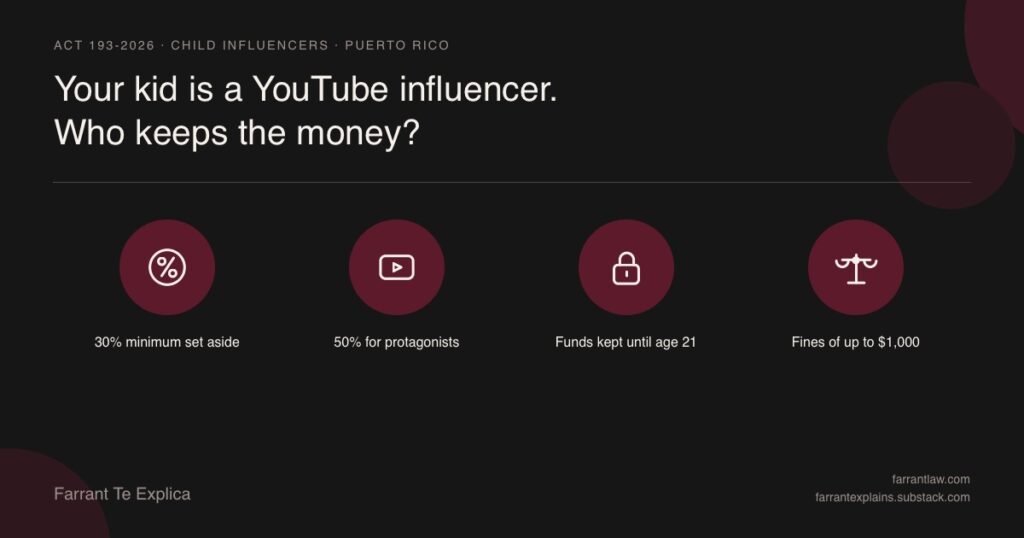
Article 4 of Law 193 establishes concrete percentages of earnings that the minor must receive. Every parent, mother, or guardian who receives income from monetized digital content featuring a minor must deposit, into the protected account, a minimum of thirty percent (30%) of income from each monetized piece of content. This amount increases to 50% when the minor appears primarily throughout the entire content—that is, if they are the video’s protagonist.
These funds will remain frozen until the minor turns 21, unless a court, based on the minor’s best interests, authorizes otherwise. When that moment arrives, Article 5 grants the young content creator 3 specific rights: to receive the total accumulated amount with interest, to demand that a platform deletes the content in which they appeared during their minority, and the ability to sue to recover any income that was not deposited as required by law.
News coverage or documentary content, non-profit educational use, and sporadic appearances in public spaces with no direct or indirect monetization attributable to the minor’s image is exempt from the law’s requirements.
Law 193 orders the Department of Labor and Human Resources to issue regulations covering labor aspects, including establishing daily limits on a minor’s exposure to digital production, within 180 days of the law’s passing. The Department is also authorized to impose fines of up to $1,000 for non-compliance. OCIF and COSSEC, meanwhile, will regulate everything related to opening and overseeing protected accounts.
How Does Puerto Rico Compare to the United States?
Puerto Rico didn’t invent this model—it borrowed and adapted it from several states that have been addressing this problem for years, though each has its own approach:
- Illinois: was the first state to protect minors’ online content when it passed its Public Act 103-556 (2023), which amended its “Child Labor Law” and created what is known as the “Illinois Child Influencer Act.” This law extends the definition of child labor to minors under 16 who appear substantially in monetized content, and uses the same percentage that Puerto Rico would later adopt: if the minor appears in 100% of the content, 50% of the gross income must be held in trust. It went into effect on July 1, 2024.
- California: protection here is much older—dating back to 1939, with the famous “Coogan Law” (California Family Code §6750-6753), created following cases of child actor exploitation in Hollywood. This law requires depositing at least 15% of earnings into what is known as a “Coogan Trust Account“. In 2024, “Assembly Bill 1880” expressly extended this protection to minors who create digital content, recognizing that “child labor” no longer occurs only on film sets.
- Minnesota: approved in 2025 the Children in Digital Content Act, the strictest approach so far. This law prohibits minors under 14 from participating in monetized digital content, and establishes that if a minor under 14 is featured by a content creator, they must receive 100% of the compensation the creator receives for this content, minus what must be paid to any other minors. For minors between 14 and 18 years old, the law requires creating a trust account where proportional compensation must be deposited. The law also recognizes the minor’s right to request that content posted during their childhood be deleted upon reaching adulthood.
- Utah: its House Bill 322 of 2025, known as the Minor Protection in Digital Media Act, follows the same pattern of mandatory trust and the right to request content removal upon adulthood.
The pattern in these legislations is clear: each state has enacted its law on top of existing legal frameworks in child labor protection (child labor or child actor laws), to extend those protections to the digital world. Puerto Rico essentially combined Illinois’s tiered percentages with Minnesota and Utah’s right to digital oblivion. However, unlike these states, it did not create a separate child labor licensing regime, but instead directly regulated money flow through protected accounts and left labor oversight (time and exposure limits) for future regulation by the Department of Labor.
How Does Law 193 Compare to the European Union?
The United States started legislation on this topic using labor law as its starting point. On the other hand, Europe started from image rights and data protection law—and the undisputed pioneer is France.
The “Loi Studer” (Law No. 2020-1266 of October 19, 2020) was the first comprehensive law on minor influencers. Its approach is different from Illinois or Puerto Rico: instead of setting a minimum reserve percentage, it classifies child influencers under 16 under the existing “children in entertainment” regime of the French Labor Code, requiring prior administrative authorization from DREETS before any commercial exploitation of their image. The portion of earnings exceeding what the law allows parents to receive—the “pécule”—must be deposited with the Caisse des Dépôts et Consignations, a public institution, rather than in a private bank account as in Puerto Rico or the states.
French law continued to evolve in 2023 when Parliament approved the Influencers Law (Law No. 2023-451), which regulated commercial transparency for all influencers, requiring written contracts and clear labeling of commercial content. However, this law drew criticism for being too stringent with content creators. Consequently, in November 2024, the French government issued Ordinance No. 2024-978 to modify the Influencers Law, relax commercial labeling requirements, and align regulation with the EU’s Digital Services Act (DSA). Through these laws, France maintains 2 parallel legal frameworks: the Loi Studer to protect child influencers as artistic workers, and the Influencers Law to regulate commercial transparency.
One area where France goes further than Puerto Rico is in the right to be forgotten: since 2020, the minor can directly demand from the platform—without needing parental consent—that content featuring them be deleted, even while they are still minors. Puerto Rico’s Law 193, by contrast, reserves that content removal right for when the content creator turns 21.
At the European Union level, there is still no specific law on “kidfluencers”—the matter is fragmented across the DSA (which in its Article 28 prohibits advertising targeted at minors on platforms), the Audiovisual Media Services Directive, and data protection law. However, the landscape is shifting rapidly: the European Parliament, in its resolution of November 26, 2025, on the protection of minors online, expressly asked the European Commission to prohibit platforms from monetizing or economically incentivizing “kidfluencing”—a significantly more aggressive stance than Illinois, California, or Puerto Rico, which regulate how the money is divided rather than prohibit the activity. That debate will likely be addressed in the EU’s forthcoming “Digital Fairness Act.”
In summary: the United States and Puerto Rico regulate how money is divided; France regulates work and prior authorization; and the European Union, as a bloc, is considering completely prohibiting the monetization of minors’ content.
Why Should This Matter to You?
If you manage a family account or channel where your children generate income from advertising, sponsorships, or affiliates, this law applies directly to you. Failing to deposit in a bank account the 30 or 50% that the Law requires you to set aside for your child constitutes a violation of the law for which your child could sue you when they turn 21.
On the other hand, if your business pays sponsorships or collaborations to accounts featuring child actors or Puerto Rican “family channels,” you should also understand this law. Although the obligation to set aside funds in a protected account rests primarily on the parent, mother, or guardian, a pattern of payments to parents you know repeatedly ignore this law could make you part of a lawsuit when that minor reaches adulthood.
How Can I Comply with the Law?
- If you manage an account or channel where your children participate, open a protected account with an institution authorized by OCIF or COSSEC as soon as possible and calculate the correct percentage (30% or 50%) you need to set aside for your child.
- Keep clear accounting of income from each piece of monetized content—advertising, sponsorships, affiliates, merchandise sales—to be able to demonstrate, if needed, that you complied with the required reserve.
- Keep the protected account completely separate from your personal accounts. Law 193 is clear that these funds cannot be used to pay your own obligations.
- If your business contracts with child influencers in Puerto Rico for ads, ask whether they have the protected account established before signing a contract.
- Stay informed of regulations that the Department of Labor and Human Resources must issue within the next 180 days, as that’s when the daily limits on a minor’s exposure to content production will be defined.
In Conclusion
Law 193 makes Puerto Rico one of just a handful of jurisdictions worldwide—alongside Illinois, California, Minnesota, Utah, and France—with a law regulating how money generated by young online content creators will be protected. The principle is straightforward: if a child’s image is used to sell, that child has a right to a portion of the income received, and those funds must be deposited in an account that no one else can touch. If you manage a family or your child’s channel in Puerto Rico, now is the time to review your finances and processes, before your own son or daughter becomes and adult and sues you in court.
Do you manage a family or child channel generating income in Puerto Rico, or does your business pay sponsorships to minor content creators? Schedule a consultation with us to make sure you’re complying with Law 193 before regulations take effect.
What do you think of Law 193? How does it compare with the other laws described here? Which do you think has the best approach? Do you think it’s right that a minor has to wait until age 21 to ask YouTube and other platforms to delete their content?
About the Author
Jaime Farrant is an attorney admitted to practice law in Puerto Rico, New York, Maryland, and the District of Columbia, with an LL.M. in International Law, focusing on privacy, cybersecurity, and AI regulation for businesses and healthcare providers.
ADVERTISING MATERIAL. This article constitutes advertising as defined under the rules of professional conduct in effect in New York (22 NYCRR 1200.7.1 and 1200.7.3), Maryland (Rule 19-307.1 and 19-307.2), and the District of Columbia (D.C. Rules of Professional Conduct 7.1), as well as the Puerto Rico Rules of Professional Conduct (Rules 7.1–7.3). It does not constitute solicitation of known prospective clients who need legal services in a particular matter. Rather, it is general information directed to the public about the practice of law and available legal services. No attorney-client relationship is created by reading this article or by contacting the author.