
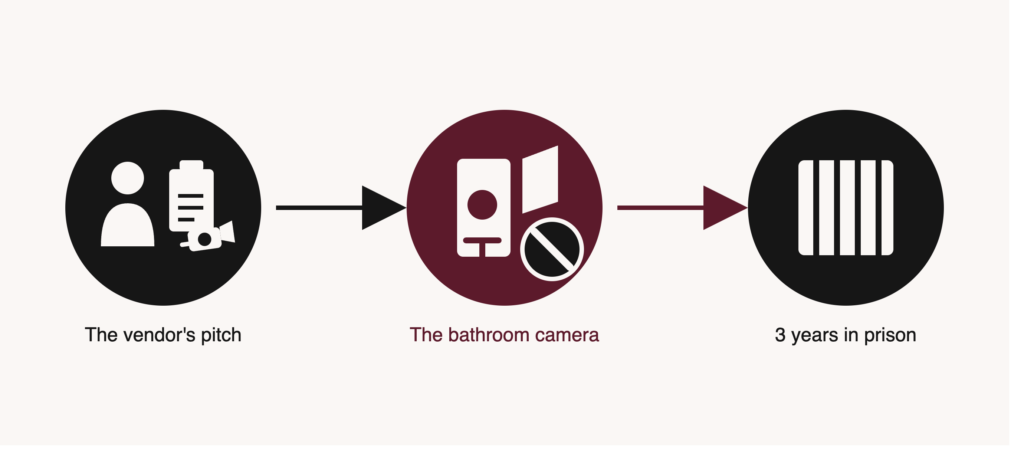
A security vendor offers you a great deal: a full camera package for your office or clinic, including units for “every room” — bathrooms included. Before you say yes, here’s the one word that should stop you: no.
Installing a camera in a bathroom isn’t a gray area. In most states, it’s either a specific criminal offense, an actionable civil tort, or both — regardless of whether you own the building, whether employees consented to “general” workplace monitoring, or whether your intent was purely about theft prevention.
All Kinds of Laws and Regulations Are Against Your Vendor’s Sales Pitch
Video surveillance law in the U.S. is a patchwork, but one principle is close to universal: people have a reasonable expectation of privacy in spaces where they may be nude or partially undressed — bathrooms, locker rooms, and changing areas top that list in nearly every jurisdiction.
The following layers of law apply here:
1. The federal wiretap/ECPA gap doesn’t help you here. Most security cameras don’t record audio, which is why they generally fall outside the federal Wiretap Act and the Electronic Communications Privacy Act (those statutes govern communications, not silent video). Business owners sometimes hear “no audio recorded, no ECPA problem” and assume that means video is unregulated. It isn’t. ECPA’s silence on soundless video just means you have to look elsewhere — and state law fills that gap fast, especially for restrooms.
2. State statutes specifically ban restroom and changing-area recording. California, for example, expressly forbids video recording in restrooms, locker rooms, and places where people change clothes. Many states have similar “video voyeurism” or “unlawful surveillance” statutes that criminalize recording — or even just installing recording equipment — in a place where someone has a reasonable expectation of privacy, whether or not any footage is ever viewed or used. These are often felony-level offenses, and consent from you as the business owner is irrelevant; the person being recorded is the one whose consent (or knowledge) matters.
3. Healthcare and other regulated settings add another layer. If you run a medical office, a bathroom camera also raises immediate collateral problems: patients or staff visible on camera in a restroom implicates dignity and privacy obligations that go well beyond HIPAA’s technical safeguards — it’s the kind of fact pattern that turns into a licensing board complaint, a media story, or both.
4. Even without a specific statute, common law will find you. Every U.S. jurisdiction recognizes some version of the tort of intrusion upon seclusion: intentionally intruding on someone’s private affairs in a way that would be “highly offensive to a reasonable person.” A camera in a bathroom is the textbook example courts use to illustrate this tort. That means even in a state without a dedicated criminal statute, an employee, patient, or customer who discovers the camera can sue you civilly — and juries tend to have little patience for this fact pattern.
What Does Puerto Rico’s Constitution and Penal Code Say?
If you operate in Puerto Rico, your exposure is arguably higher than in the 50 states, as the right to privacy here isn’t left to a patchwork of state statutes and common-law torts. It’s written directly into the Constitution.
Article II, Section 8 of the Puerto Rico Constitution states: “Toda persona tiene derecho a protección de ley contra ataques abusivos a su honra, a su reputación y a su vida privada o familiar” (Every person has the right to protection of law against abusive attacks on their honor, reputation, and private or family life). What makes this different from the U.S. Constitution is that the Puerto Rico Supreme Court has held that this right applies directly between private parties, not just against government action. In Arroyo v. Rattan Specialties, Inc., 117 D.P.R. 35 (1986), the Court held that the right to privacy operates ex propio vigore — on its own force — and can be asserted by one private citizen against another, including an employer against an employee. That means a bathroom camera dispute in Puerto Rico doesn’t need a separate statute to become a constitutional violation; the Constitution itself solves the controversy.
The Puerto Rico Penal Code then backs this up with a specific criminal provision. Article 168 of the Puerto Rico Penal Code, titled “Illegal recording of images”, makes it a crime for any person, without legal justification or a legitimate investigative purpose, to use electronic or digital video equipment — with or without audio — to conduct secret surveillance in private places, or in any other place where a reasonable expectation of privacy exists. A bathroom is about as clear an example of that as exists. Conviction of this crime carries a 3 year imprisonment penalty, and if the convicted party is a corporation (or any legal person), they face a criminal fine of up to $10,000, on top of civil liability.
Put together, that’s 3 independent legal problems stacked on top of each other for accepting the salesperson’s offer: a constitutional privacy violation that doesn’t require a lawsuit-specific statute to exist, a specific criminal statute naming the conduct, and civil liability for damages. There’s no version of “we didn’t think it applied to us” that survives this situation.
What Will “Getting This Wrong” Cost You?
You will face real exposure across all fronts, notably:
- Criminal liability: Many state voyeurism/unlawful surveillance statutes are felonies, carrying fines and potential jail time for the person who installs or operates the equipment — that could be you, personally, not just “the business.”
- Civil damages: Intrusion-upon-seclusion claims, among other tort claims, can result in compensatory damages, and courts in the US have allowed punitive damages where the conduct is found egregious — a bathroom camera is close to the paradigm case.
- Employment claims: If the person recorded is an employee, expect this to also surface as a hostile work environment or wrongful termination claim if discipline follows the discovery.
- Reputational cost: Unlike a data breach notice, this is the kind of story that runs on local news with your business’s name in the headline. There’s no regulator fine that costs you more than the client and patient trust it destroys.
Why Should You Care About This?
Because although you might think the sales pitch sounds reasonable, you could end up in a lot of trouble. “Fully covered and protected business” sounds like a good security practice, and most business owners installing these systems aren’t trying to do anything invasive — they’re thinking about delivery problems, break-ins, shoplifting, and slip-and-fall liability. However, your good intent doesn’t matter for most of these statutes, and it won’t matter to a jury either. The law doesn’t ask whether you meant well; it asks whether a reasonable person would find being recorded in that space highly offensive. In a bathroom, the answer is already decided.
This is also a useful moment to audit your entire camera plan, not just the bathroom question — because the same vendor conversation is a good opportunity to think through where cameras are legally fine (entrances, sales floors, hallways, parking areas) versus where they cross the line (restrooms, break-rooms used for nursing mothers, private offices with an expectation of confidentiality).
What Can You Do to Comply?
- Decline any bathroom, locker room, or changing-area camera outright. There’s no notice, consent form, or signage that fixes this. Don’t install it, and don’t let a vendor bundle it into a package “in case you change your mind.”
- Map your camera locations against expectation-of-privacy zones. Entrances, registers, storage, parking, and common work areas are generally fine. Restrooms, changing rooms, and private offices are not.
- Put your monitoring policy in writing. For the cameras you do install, a written policy — reviewed by an attorney — that discloses locations, purpose, and retention helps establish notice and reduces the risk of a monitoring-related claim from staff.
- Check your state’s specific statute. Voyeurism and unlawful-surveillance laws vary — some cover only “for sexual gratification” purposes, others cover any recording in a private space regardless of purpose. If you operate in Puerto Rico, the relevant provision is Article 168 of the Penal Code — broader than many mainland statutes since it isn’t limited to a sexual-purpose requirement.
- Train whoever manages the footage. Access controls and retention limits for legitimate camera footage matter too — who can view it, how long it’s kept, and how it’s secured.
The Bottom Line
Say yes to the cameras. Say no to the bathroom units — every time, no exceptions, regardless of how the package is bundled or how good the discount is. This is one of the few areas of privacy law where there’s no compliant way to do the thing at all; the only right answer is not installing it.
If you’re building out a security camera plan for your office, clinic, or retail space and want a compliance check before you sign anything, book a consultation — better to ask before the cameras go up than after.
This post is for general informational purposes and does not constitute legal advice. Camera and surveillance laws vary by state; consult an attorney about the rules that apply to your specific location and industry.
About the Author
Jaime Farrant is admitted to practice law in Puerto Rico, New York, Maryland and the District of Columbia. This article is for informational purposes only and does not constitute legal advice or create an attorney-client relationship.
ADVERTISING MATERIAL. This article constitutes advertising as defined by the professional conduct rules in New York (22 NYCRR 1200.7.1 and 1200.7.3), Maryland (Rule 19-307.1 and 19-307.2), and the District of Columbia (D.C. Rules of Professional Conduct 7.1), and the Puerto Rico Rules of Professional Conduct (Rules 7.1-7.3). It is not solicitation of prospective clients known to need legal services in a particular matter. Instead, it is general information directed to the public about the practice of law and available legal services. No attorney-client relationship is created by your reading of this article or by contacting the author. Consult qualified counsel in each jurisdiction with specific situations.