
In our article published 2 weeks ago, we talked about how using AI to screen résumés exposes you to laws that prohibit workplace discrimination. Today, we want to focus on the risks you face if you operate in Puerto Rico under a law that almost no vendor will mention when you’re evaluating an automated “screening” tool: Law Num. 100 of June 30, 1959, Puerto Rico’s employment discrimination law, which applies even though its text doesn’t contain the word “algorithm” — and adds consequences that neither U.S. federal law nor the European Union impose.
What Does Law 100 Presently Say?
Before 2017, Law 100 gave employees a powerful tool: it provided that an adverse action — such as failing to hire, failing to promote, or terminating someone — taken without just cause, was presumed to be discriminatory. Once the employee triggered that presumption, the burden shifted almost entirely to the employer, who then had to affirmatively prove that no discrimination had occurred.
That changed with the Labor Transformation and Flexibility Act (Law 4 of 2017), which eliminated that presumption in order to align Puerto Rico with the federal standard known as McDonnell Douglas. Today, a claim under Law 100 works much like a federal one: the employee must establish a preliminary case (that they belong to a protected class, that they were qualified, that an adverse action occurred, and that similarly situated people outside that protected class were treated better). Once an employee does this, the employer must articulate a legitimate, non-discriminatory reason for the decision. If the employer does so, the burden shifts back to the employee, who must then prove that reason was pretextual.
In short: today, the burden of persuading the court that discrimination occurred rests more on the employee than on the employer.
However, AI introduces a real problem for employers even under this favorable standard. As mentioned above, the second step of the analysis requires you to be able to articulate a legitimate reason for the rejection. If your entire process was uploading résumés to a third-party tool and letting an algorithm screen them out, what is your legitimate reason for rejecting them? Answering “The system gave them a lower score” isn’t always enough — especially if the candidate can show, through statistics (as allowed under Title VII’s disparate-impact theory), that the tool’s rejection pattern — for example, disproportionately screening out women for a position — correlates with a protected category. In that scenario, your inability to explain the decision becomes the very evidence of pretext the candidate or employee needs to prevail.
That said, even though the burden of proof is no longer automatically stacked against the employer, Law 100 still has something Title VII doesn’t: harsher penalties, discussed below.
What Are the Penalties Under Law 100?
Law 100 imposes civil liability on the employer for double the damages caused (or between $500 and $2,000 if damages cannot be determined). In addition, discriminatory conduct may constitute a misdemeanor, punishable by a fine of up to $5,000 or up to 90 days in jail, or both. None of this exists under any federal anti-discrimination law. As a result — although it is uncommon for these cases to be prosecuted criminally — using AI to screen résumés could technically expose you to criminal liability in Puerto Rico. It’s a consequence many employers don’t know about or anticipate.
How Is This Regulated in Other Jurisdictions?
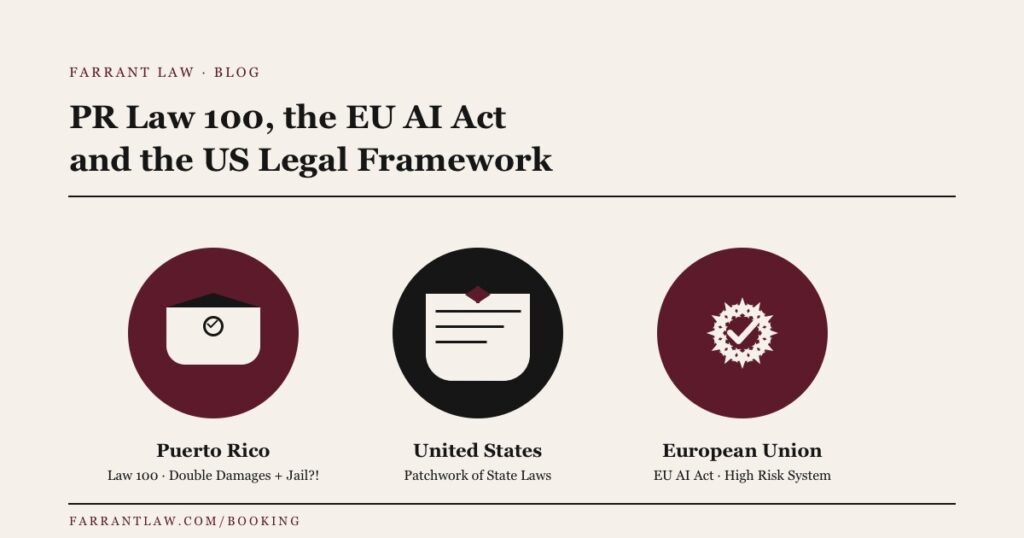
- United States: there is no single federal law governing AI in employment. Instead, there’s a patchwork of local and state rules — New York City’s Local Law 144, which mandates bias audits; Illinois’s requirement to notify candidates when AI is used to analyze video interviews; Colorado’s risk assessments — layered on top of existing federal anti-discrimination laws (Title VII, ADEA, ADA) enforced by the EEOC and interpreted under the U.S. Supreme Court’s McDonnell Douglasstandard. All of these can be boiled down to: you’re allowed to use AI tools, but be ready to justify them if challenged — and know the specific compliance requirements in whatever state you operate in or evaluate candidates from.
- European Union: if your company works with candidates or employees in the EU, or you simply want to understand where AI regulation is headed globally, it’s worth looking at the EU AI Act (Regulation (EU) 2024/1689), already in force, and likely the most comprehensive legal framework on artificial intelligence in the world today. The EU AI Act classifies AI tools used for recruitment and personnel selection — including filtering job applications and evaluating candidates — as “high-risk” systems. That means that before they can be legally used, the tool must undergo a conformity assessment, have technical documentation, risk-management systems, human-oversight mechanisms, and be registered in an EU database. Employers also have a specific obligation to inform workers and their representatives of the system’s existence before using it. In the European Union, unlike in Puerto Rico and the United States, an employer must demonstrate that its platform is safe before using it.
The difference in approach is significant. While the EU certifies the tool before it’s used, Puerto Rico and the United States require nothing upfront, but impose legal consequences if the tool produces a discriminatory result.
Why Should This Matter to You?
Because using AI that discriminates against candidates puts you at risk of paying damages — and if you’re in Puerto Rico, it puts you at risk of criminal liability.
Think about it in practical terms: if your AI tool disproportionately rejects candidates of a certain age or background, and a candidate manages to prove pretext — for example, by showing that you couldn’t coherently explain why the system screened them out — you face the possibility of having to compensate the people affected by the algorithm, and of being held criminally responsible for having used it. For a small business or a clinic, that’s a genuinely significant exposure that goes beyond what you’d anticipate if you only looked at federal law as your benchmark, or if you assumed you were covered because ChatGPT was built “without any intent to discriminate” or because you used the AI tool in “good faith.”
How Can I Comply With the Law?
- Always have an articulable reason for every rejection. “The system gave candidate X a lower score” isn’t enough on its own. You need to be able to explain, in concrete terms tied to the job’s qualifications, why a candidate didn’t move forward in the interview process.
- Demand documentation from your vendor. Ask whether the tool has been bias-audited, how often, and whether they’ll provide you that documentation. That evidence is what lets you satisfy the “articulate a legitimate reason” step if it is challenged.
- Keep a record of every decision. What data went in, what score or result the system produced, and what human review occurred before each final decision. That log is your evidence if you ever need to defend the process.
- Notify candidates that you use AI in the process. It’s good practice in Puerto Rico, and it’s already mandatory under the EU AI Act if you have candidates or employees in Europe.
- Run a risk assessment before adopting the tool — not after the first complaint. Ask yourself: what data was it trained on? Which protected categories might it be indirectly affecting? Remember that Law 100 protects, among others: age, race, color, sex, sexual orientation, gender identity, social or national origin, social condition, political affiliation, political or religious beliefs, being a victim (or perceived victim) of domestic violence/sexual assault/stalking, veteran status, marital status, and even certain hairstyles and hair textures associated with particular racial identities or national origins.
- Review your contract with the vendor. Who’s responsible if the tool produces a discriminatory result? Negotiate that clause if you can.
The Bottom Line
Since the 2017 labor reform, Law 100 no longer puts you in a worse evidentiary position than federal law. What does set Puerto Rico apart is what happens if you lose: double damages and the possibility of criminal liability, neither of which exists under Title VII. Remember, too, that if you can’t explain why your tool rejected a candidate, you may already be in violation of the law. Finally, remember that you need to keep your processes documented, make sure they’re supervised by people, and be able to explain and justify every decision. Know and formalize your processes before you’re forced to do so in front of a government agency or a court.
Do you think your current AI-driven hiring process could expose you to legal liability under Ley 100 if a candidate filed a complaint today — or do you just want to make sure your processes are compliant? Let’s talk. Book a consultation here.
About the Author
Jaime Farrant is admitted to practice law in Puerto Rico, New York, Maryland and the District of Columbia. Practice in all other jurisdictions is limited to immigration law. This article is for informational purposes only and does not constitute legal advice or create an attorney-client relationship.
ADVERTISING MATERIAL. This article constitutes advertising as defined by the professional conduct rules in New York (22 NYCRR 1200.7.1 and 1200.7.3), Maryland (Rule 19-307.1 and 19-307.2), and the District of Columbia (D.C. Rules of Professional Conduct 7.1), and the Puerto Rico Rules of Professional Conduct (Rules 7.1-7.3). It is not solicitation of prospective clients known to need legal services in a particular matter. Instead, it is general information directed to the public about the practice of law and available legal services. No attorney-client relationship is created by your reading of this article or by contacting the author. Consult qualified counsel in each jurisdiction with specific situations.