En nuestro artículo de hace 2 semanas, hablamos sobre como usar IA para filtrar résumés te expone a leyes que prohiben el discrimen en el trabajo. Hoy queremos enfocarnos en los riesgos que tienes si operas en Puerto Rico bajo una ley que seguramente nadie te mencionará cuando evalúas una herramienta de “screening” automatizado: la Ley Núm. 100 de 30 de junio de 1959, nuestra ley contra el discrimen en el empleo, la cual aplica aunque su texto no contenga la palabra “algoritmo” — y añade consecuencias que las leyes federales y la Unión Europea no tienen.
¿Qué dice la Ley 100 Actualmente?
Antes del 2017, la Ley 100 tenía una herramienta poderosa a favor del empleado, ya que establecía que una acción adversa — como no contratar, no ascender, despedir a una persona— tomada sin justa causa, se presumía discriminatoria. Una vez el empleado activaba esa presunción, la carga pasaba casi por completo al patrono, quien tenía que probar afirmativamente que no hubo discrimen.
Eso cambió con la Ley de Transformación y Flexibilidad Laboral (Ley 4 de 2017), que eliminó esa presunción para alinear a Puerto Rico con el estándar federal conocido como McDonnell Douglas. Hoy, un reclamo bajo la Ley 100 funciona de forma muy parecida a uno federal: el empleado debe establecer un caso preliminar (que pertenece a una clase protegida, que estaba cualificado, que hubo una acción adversa, y que otros en circunstancias similares fuera de esa clase protegida fueron tratados mejor). Si lo logra, el patrono debe articular una razón legítima y no discriminatoria para la decisión. Si el patrono hace esto, la carga vuelve al empleado, quien debe probar que esa razón fue un pretexto.
En resumen, hoy día, la carga de persuadir al tribunal que hubo discrimen recae más sobre el empleado que el patrono.
No obstante, la IA introduce un problema real para un patrono incluso bajo este estándar más favorable. El segundo paso del análisis te exige poder articular una razón legítima para el rechazo. Si tu único proceso fue subir résumés a una herramienta de terceros y dejar que un algoritmo los descartara, ¿cuál es tu razón legítima para rechazarlos? “El sistema le dio menor puntaje” no siempre basta, sobre todo si el candidato puede mostrar —con estadísticas, como permite la teoría de impacto discriminatorio bajo Título VII— que el patrón de rechazos de la herramienta, como por ejemplo, que descarta mayormente mujeres para una posición, correlaciona con una categoría protegida. En ese escenario, la falta de explicación se convierte en la evidencia de pretexto que el empleado necesita para prevalecer
Por otro lado, aunque la carga de la prueba ya no está automáticamente en contra del patrono, la Ley 100 sigue teniendo algo que el Título VII no tiene: penalidades más severas, que veremos a continuación.
¿Cuáles son las penalidades bajo la Ley 100?
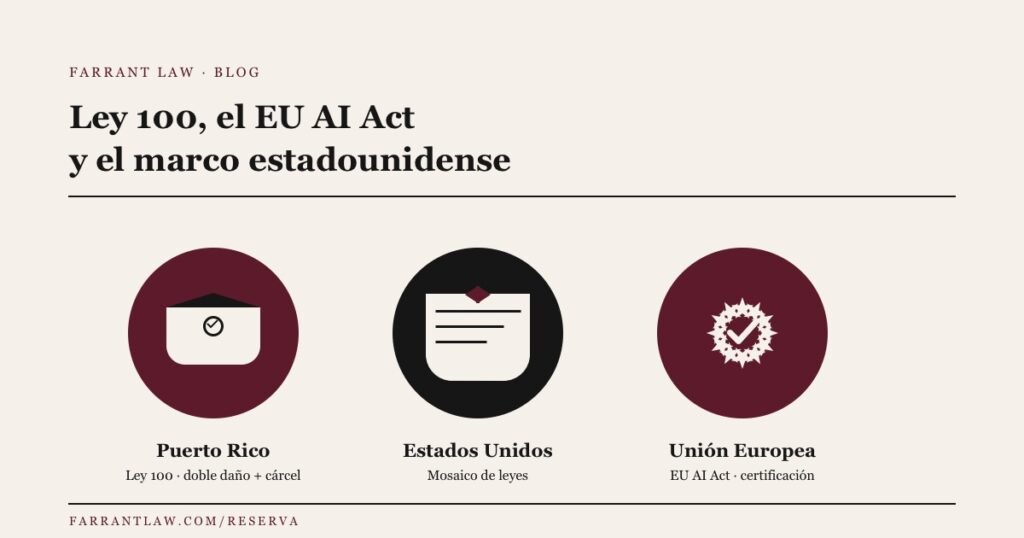
La Ley 100 impone responsabilidad civil al patrono por el doble de los daños causados (o entre $500 y $2,000 si los daños no se pueden determinar). Además, la conducta discriminatoria podría constituir un delito menos grave, castigado con multa de hasta $5,000 o cárcel de hasta 90 días, o ambas penas. Nada de esto existe bajo ninguna ley antidiscrimen federal. Por consiguiente, aunque es inusual que estos casos se persigan criminalmente, el usar IA para revisar résumés podría técnicamente exponerte a responsabilidad penal en Puerto Rico. Es una consecuencia que muchos patronos no conocen o anticipan.
¿Cómo está regulado este tema en otras jurisdicciones?
- Estados Unidos: no existe una ley federal sobre IA en el empleo. En su lugar, hay un mosaico de leyes locales y estatales tales como la Local Law 144 de la ciudad de Nueva York que impone auditorías de sesgo (bias audits), la notificación a un candidato cuando sea entrevistado en video por IA en Illinois, las evaluaciones de riesgo de Colorado, además de las leyes federales antidiscrimen ya existentes (Título VII, ADEA, ADA) por la EEOC, las cuales se interpretan bajo el estándar del caso del Tribunal Supremo de Estados Unidos McDonnell Douglas. Todas estas leyes y ordenanzas pueden reducirse a que permiten el uso de herramientas de IA, pero prepárate para justificarla si alguien la cuestiona y además, conoce los requisitos específicos de cumplimiento que existan en el estado donde trabajas o evaluas candidatos.
- Unión Europea: si tu empresa trabaja con candidatos o empleados en la Unión Europea, o si simplemente quieres entender hacia dónde va la regulación de IA en el mundo, vale la pena mirar el EU AI Act (Reglamento (UE) 2024/1689), que ya está en vigor, y es probablemente el cuerpo legal más comprensivo en el mundo actualmente sobre la Inteligencia Artificial. El EU AI Act clasifica las herramientas de IA usadas para reclutamiento y selección de personal —incluyendo filtrar solicitudes de empleo y evaluar candidatos— como sistemas de “alto riesgo.” Eso significa que, antes de poder usarse legalmente, la herramienta debe pasar por una evaluación de conformidad, tener documentación técnica, sistemas de gestión de riesgo, mecanismos de supervisión humana, y registrarlos en una base de datos de la UE. Además, el patrono tiene la obligación específica de informar a los trabajadores y sus representantes de la existencia de este sistema antes de utilizarlo. En la Unión Europea, contrario a Puerto Rico y Estados Unidos, un patrono necesita demostrar que su plataforma es segura antes de usarla.
Las diferencias en enfoque son significativas. Mientras en la UE se certifica la herramienta previo a su uso, en Puerto Rico y Estados Unidos no se exige nada por adelantado, pero se imponen consecuencias legales si la herramienta produce un resultado discriminatorio.
¿Por Qué Debe Importarte Esto?
Porque usar un IA que discrimina contra candidatos te pone en riesgo de pagar indemnización y, si estás en Puerto Rico, te pone en riesgo de ir a la cárcel.
Piénsalo en términos prácticos: si tu herramienta de IA rechaza desproporcionadamente a candidatos de cierta edad u origen, y un candidato logra probar pretexto —por ejemplo, mostrando que no pudiste explicar de forma coherente por qué el sistema lo descartó, enfrentas la posibilidad de indemnizar a las personas afectadas por el algoritmo y de ser responsable penalmente por haberlo usado. Para un negocio pequeño o una clínica, esa es una exposición realmente significativa que va más allá de lo que anticiparías si sólo miras las leyes federales como referencia o si descansas en que ChatGPT fue hecho “sin intención de discriminar” o porque usaste la herramienta de IA de “buena fe”.
¿Cómo Puedo Cumplir con la Ley?
- Ten siempre una razón articulable para cada rechazo. No basta con “el sistema le dio menor puntaje a X candidato.” Debes poder explicar, en términos concretos y relacionados con las cualificaciones del puesto, por qué un candidato no avanzó en el proceso de entrevistas.
- Exígele documentación al vendedor. Pregunta si la herramienta ha sido auditada por sesgo, con qué frecuencia, y si te proveen esa documentación. Esa evidencia es lo que te permite cumplir con el paso de “articular una razón legítima” si te cuestionan.
- Guarda un registro de cada decisión. Qué datos entraron, qué puntaje o resultado produjo el sistema, y qué revisión humana se hizo antes de las decisiones finales. Esa bitácora es tu evidencia si algún día tienes que defender el proceso.
- Notifica a los candidatos que usas IA en el proceso. Es buena práctica en Puerto Rico y ya es obligatorio bajo el EU AI Act si tienes candidatos o empleados en Europa.
- Haz una evaluación de riesgo antes de adoptar la herramienta, no después de la primera querella. Pregúntate: ¿con qué datos fue entrenada? ¿Qué categorías protegidas podría estar afectando indirectamente? Recuerda que la Ley 100 protege, entre otras, edad, raza, color, sexo, orientación sexual, identidad de género, origen social o nacional, condición social, afiliación política, ideas políticas o religiosas, ser víctima de violencia doméstica/agresión sexual/acecho, condición de veterano, estado civil, y hasta ciertos peinados y texturas de cabello asociadas a identidades raciales u orígenes nacionales particulares.
- Revisa el contrato con el vendedor. ¿Quién asume responsabilidad si la herramienta produce un resultado discriminatorio? Negocia esa cláusula si puedes.
En Resumen
Desde la reforma laboral de 2017, la Ley 100 ya no te coloca en una posición probatoria peor que la ley federal — el análisis hoy se parece bastante al estándar de McDonnell Douglas. Lo que sí distingue a Puerto Rico es lo que pasa si pierdes: daños dobles automáticos y la posibilidad de responsabilidad penal, ninguno de los cuales existe bajo el Título VII. Recuerda además que si no puedes explicar por qué tu herramienta rechazó a un candidato, podrías estar violando la ley. Finalmente, recuerda que necesitas mantener documentados tus procesos, asegurarte que sean supervisados por personas, y que puedas explicar y justificar cada decisión. Conoce y formaliza tus procesos antes que necesites hacerlo frente a una agencia gubernamental o un tribunal.
¿Piensas que tus procesos de contratación actuales con IA te dejarían expuesto a responsabilidad legal bajo la Ley 100 si un candidato presenta una querella hoy, o simplemente quieres asegurarte de tener procesos que cumplen con la ley? Conversemos. Agenda una consulta aquí.
Sobre el Autor
Jaime Farrant es un abogado admitido para ejercer derecho en Puerto Rico, Nueva York, Maryland y el Distrito de Columbia. La práctica legal en cualquier otro estado está limitada al derecho de inmigración.
MATERIAL PUBLICITARIO. Este artículo constituye publicidad tal como se define en las reglas de conducta profesional en vigor en Nueva York (22 NYCRR 1200.7.1 y 1200.7.3), Maryland (Rule 19-307.1 y 19-307.2) y el Distrito de Columbia (D.C. Rules of Professional Conduct 7.1), así como en las Reglas de Conducta Profesional de Puerto Rico (Reglas 7.1-7.3). No constituye inducción a clientes potenciales conocidos que necesiten servicios legales en un asunto particular. Por el contrario, se trata de información general dirigida al público sobre el ejercicio del derecho y los servicios legales disponibles. Ninguna relación abogado-cliente se crea por la lectura de este articulo o por contactar al autor.